
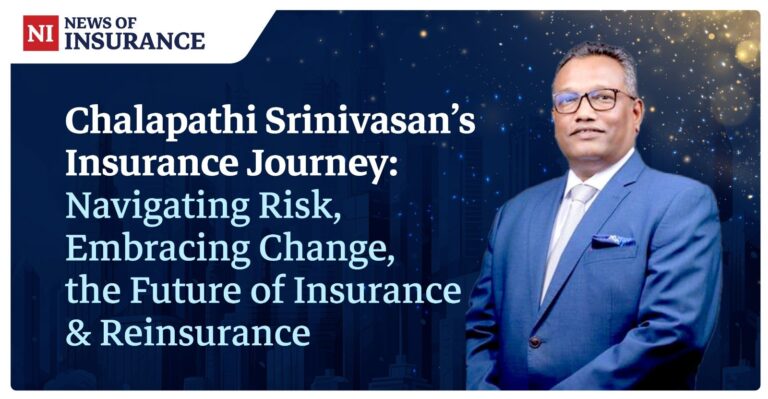
Navigating Risk, Embracing Change, the Future of Insurance and Reinsurance
By News of Insurance
In an era where global risks—from climate change to cyber threats—are reshaping how insurers and reinsurers operate, few voices carry the weight of experience and foresight like Chalapathi Srinivasan. With over 30 years in the insurance industry, spanning India and the Middle East, he has worn many hats: underwriter, broker, risk strategist, and mentor. Today, he serves as a senior leader at a leading insurance broking firm in Dubai, guiding clients and teams through some of the most complex challenges the industry has ever faced.
Born in India and trained in the art and science of underwriting, Srinivasan’s career reflects the industry’s evolution—from manual risk assessment in the 1990s to today’s AI-driven modeling. His journey took a pivotal turn when he relocated to the UAE, where he embraced a multicultural, fast-paced business environment. Over the years, he has built deep expertise in property, marine, energy, and specialty insurance, as well as in complex reinsurance placements.
In this exclusive News of Insurance interview, Srinivasan reflects on his career, shares insights on climate change’s impact on the insurance sector, discusses the rise of predictive technologies, and offers advice to the next generation of industry professionals. His perspective blends technical mastery with an unwavering belief in adaptability—a quality he considers essential for anyone navigating risk in the 21st century. Here are the excerpts of his interview:
Let’s start with your journey. How did you first enter the insurance industry, and what drew you to it?
My entry into insurance was, in some ways, serendipitous. In the early 1990s, I began my career in India at a time when the market was still government-controlled. Insurance wasn’t considered a glamorous profession; banking and IT were the bigger draws. But I was fascinated by the idea that insurance was not just about selling a policy—it was about understanding risk, predicting potential losses, and helping people and businesses recover when things went wrong. That combination of analytical thinking and human impact really appealed to me. Over time, I realized insurance was also a passport to the world, because risk has no borders.
You’ve now spent significant time working in the Middle East. How does the UAE insurance market differ from what you experienced in India?
The UAE market is much more open, competitive, and cosmopolitan. In India, at least in the earlier part of my career, regulations were tight and international players were few. The UAE, on the other hand, is a hub where brokers, insurers, and reinsurers from across the world converge. You’re dealing with clients from different nationalities, different industries, and often very sophisticated risk requirements. The pace is faster, and the regulatory environment—while robust—is designed to encourage innovation and competition. That makes it an exciting place to work, but also one where you need to be on top of your game every single day.
Climate change is often called the biggest challenge for insurers today. From your perspective, who feels the impact more—the cedent or the reinsurer?
Both feel it, but in different ways. Cedents—primary insurers—face the immediate pressure of paying claims when a climate-related event like a flood or hurricane hits. They’re on the front line with the insured. Reinsurers, meanwhile, are the safety net, so they take on large, accumulated losses from multiple cedents across regions. When climate events become more frequent and severe, both ends of the chain are stressed. The reinsurer’s challenge is that their exposure is global; a single bad season in multiple geographies can affect their profitability significantly. That’s why climate modeling, predictive analytics, and diversification are now central to reinsurance strategy.
Can you share a specific example of how climate change has altered underwriting or broking practices?
Certainly. Ten years ago, if we were insuring a coastal property, the flood risk maps were relatively static. You’d use historical data from the last few decades to estimate frequency and severity. Today, those maps are almost obsolete because sea levels are rising, storm patterns are changing, and rainfall variability has increased. We now use dynamic models that incorporate satellite data, seasonal weather predictions, and climate science projections. Brokers and underwriters collaborate closely to adjust terms and pricing more frequently, sometimes mid-year, to reflect new realities. In short, climate change has turned risk assessment from a static process into a living, continuously updated system.
Technology has been a recurring theme in your career. Which emerging tech do you think will most transform insurance in the next decade?
Artificial intelligence is the clear front-runner. We’re moving toward AI not just as a tool for automation but as a true partner in decision-making. For instance, AI-driven claims triage can instantly flag potential fraud, fast-track simple claims, and route complex cases to specialists. Blockchain is also promising for transparency in policy issuance and claims settlement, especially in marine and cargo insurance where documentation is complex. Then there’s the Internet of Things—devices that provide real-time data on vehicle driving behavior, factory machinery health, or home fire risks. All of these will help us shift from “repair and replace” to “predict and prevent.”
The talent pipeline is a concern in many industries. How is insurance doing in attracting and retaining young professionals?
We’re making progress, but the perception problem remains. Young graduates often don’t see insurance as dynamic or impactful, which is unfortunate because it touches every sector—health, travel, aviation, energy, technology. The way forward is to connect the dots for them: show that an underwriter in energy is helping keep the lights on in a city, or that a claims specialist in health is enabling life-saving treatments. We also need to offer flexible work arrangements, continuous learning, and clear career pathways. Mentorship is key—I’ve personally mentored several young colleagues who are now in leadership roles, and that’s deeply satisfying.
What was the toughest challenge in your career, and how did you overcome it?
In 2008, during the global financial crisis, we saw a sharp contraction in certain insurance lines. Clients were cutting costs aggressively, and risk appetite among insurers plummeted. We had to renegotiate treaties, sometimes on very tight deadlines, and with reinsurers who were themselves under pressure. The key to navigating that period was trust—relationships built over years meant that we could have honest conversations about capacity, pricing, and risk sharing. It reinforced for me that in our industry, your credibility is your greatest currency.
You’ve worked in both underwriting and broking. How do these perspectives complement each other?
Underwriting teaches you to assess and price risk accurately, balancing caution with competitiveness. Broking, on the other hand, teaches you to advocate for the client, find creative solutions, and navigate market relationships. Having both perspectives means I can approach a placement with a realistic view of what the market will accept, while still pushing for the best possible outcome for the client. It’s like speaking two languages fluently—it makes you more effective in negotiations.
What role does regulatory evolution play in shaping the industry here in the UAE?
A huge role. The UAE’s regulators have been proactive in aligning with international best practices while tailoring rules to the region’s unique needs. Solvency requirements, conduct of business rules, and guidelines on technology adoption have all improved market discipline. At the same time, there’s support for innovation—sandbox environments where insurers and tech firms can test new solutions without full-scale regulatory burden. This balance between control and creativity is part of why Dubai, in particular, has become a hub for insurance and reinsurance.
Which sectors do you see as growth hotspots for insurance and reinsurance in the Middle East?
Renewable energy is a big one, driven by national visions like the UAE Energy Strategy 2050. We’re also seeing growth in cyber insurance as businesses digitize rapidly. Large infrastructure projects, from ports to rail networks, are generating demand for specialized covers. In reinsurance, the region is becoming an important market for specialty lines like aviation, marine hull, and political risk, particularly as trade routes diversify.
How do you personally approach mentoring in such a technical and regulated field?
I start by demystifying the jargon. If a newcomer can’t explain a policy clause to a layperson, they haven’t fully understood it themselves. I also give them real case studies—claims that went well, and claims that went wrong—and we dissect them together. Finally, I encourage them to build networks early. Technical skills will get you through the door, but relationships will carry you forward.
Looking back, what career decision are you most proud of?
Moving to the UAE was a pivotal choice. It pushed me out of my comfort zone, exposed me to global markets, and allowed me to work with an incredibly diverse set of clients and colleagues. It’s a decision that broadened both my professional skills and my worldview.
What advice would you give to someone starting out in insurance today?
Be curious. Don’t limit yourself to one line of business or one market. Learn about property, marine, health, liability—because risks are interconnected. Also, invest in your analytical skills; the ability to interpret data will be as important as relationship management. And finally, remember that our business is ultimately about people. Treat every interaction as an opportunity to build trust.
Where do you see the insurance and reinsurance industry in 2035?
I think by 2035, we’ll see a fully integrated ecosystem where data flows seamlessly between clients, brokers, insurers, and reinsurers in real time. Predictive analytics will be embedded in every step—from risk selection to claims settlement. Parametric insurance, which pays out based on pre-agreed triggers like wind speed or rainfall, will be mainstream for climate-related risks. The industry will be more collaborative, less adversarial, because the scale of risks will demand joint solutions.
Finally, how do you define success in your career?
For me, success is when a client comes back to you not just because you got them a competitive rate, but because they trust you to guide them through uncertainty. It’s also about seeing people I’ve mentored rise to positions of influence and knowing I played a small role in their journey. Numbers matter in our business, but legacy is measured in relationships.
Closing Note
Chalapathi Srinivasan’s career is proof that adaptability, technical skill, and human connection are the cornerstones of success in insurance and reinsurance. As the industry faces unprecedented challenges—from climate volatility to digital disruption—leaders like him remind us that navigating risk is not about avoiding uncertainty, but about preparing for it with foresight, innovation, and trust. For young professionals and seasoned players alike, his journey offers both a blueprint and an inspiration.

 About Us
Response